

Listening Between the Lines: What We Learn When Leaders Laugh
Subtle signals of trust, resentment, and what the AI transcript leaves out

Before you even see a report on your organization’s big initiative, laughter might be a leading indicator of what’s happening.
A laugh is more than a reaction to something funny—it’s real-time data. If you know how to decode it, a single moment of humor can reveal either a crucial alignment that anchors your culture or a hidden strain that warns you where trust is leaking before a crisis hits.
Maybe you can relate to one of the following scenarios.
The first is one of my monthly coaching conversations with a leader. She wanted to discuss her role in an upcoming presentation to stakeholders about a decision directed by her CEO—a shift that would dramatically affect her team and the organization’s public-facing work for the entire year ahead. She laughed before she even mentioned the topic. A dozen more moments of humor followed, each with a different context and insight as we explored the stakes of her situation.
The second is a season in my career when pressure had become intense. In one particular meeting with my team, I noticed myself laughing a little too much at a joke. For the most part, the team seemed to be having fun, but I could tell they were puzzled by what I’d found so funny. I recognized my own laughter as a telltale sign of the stress I had been buffering between my leadership expectations and their daily work. Our shared laughter contained layers of meaning.
Laughter is a serious signal—compelling enough that business schools now teach leaders how to use humor for a strategic edge. Here, we flip the perspective and use it as a guide to listen between the lines of workplace communication.1,2
Prefer to hear me read this article?
Click play for the full 20-minute audio version.
Understanding Our Impulse to Laugh
Across centuries of history, psychologists and philosophers have come up with three prevailing theories to explain why humans laugh.
The oldest recorded theory, superiority, traces back to Plato and Aristotle, suggesting that laughter is a sudden delight in response to the failings or misfortunes of others. While this theory exposes a cruel side of humor, it also describes slapstick comedy.
The theory of incongruity may have emerged around that same time, based on the idea that we laugh when something unexpected happens. Think of a pun or a punchline that catches you by surprise. Or when a child says the darndest thing with startling clarity.
In modern psychology, especially that associated with Sigmund Freud, the relief theory describes laughter as a release of pent-up energy. This laughter is a counterweight to stress, anxiety, and even anger. Sometimes it’s a way to broach a taboo topic out loud.
They’re fascinating theories—and they can all play out in the same joke.
But here’s what Plato, Aristotle, and Freud didn’t have to navigate: a sudden strategic pivot, a hybrid team on Slack, or the challenge of figuring out what AI means for your organization.
At work, laughter becomes a nonverbal commentary on power. To read a room today, we have to interpret what laughter is actually telling us.
Decoding the Subtext of the System
Every organization has a structure that comes with unwritten rules about who is allowed to say what and when. Laughter lives in the cracks of psychological safety, sometimes coming out of hiding to build connection and other times staying almost imperceptible due to fear. It can be a quick way to express what needs no explanation because everyone is already in on the joke. Or it can be a socially acceptable proxy for unsayable truths.
In the coaching session I mentioned, my client’s laughter revealed the freedom within our established partnership. It’s a protected space for vulnerability and boldness. But in my past team meeting, my laughter became a placeholder for what I could not safely share, giving me a brief respite and indicating the need to examine my leadership practices.
In both cases, one contributing reason for laughter was an involuntary response to leadership anxiety that occurs when we face a real or perceived threat to our control, identity, or security. But another reason was a positive affiliation in a shared experience.
When a person is processing so much at once, laughter can express various contradictory emotions. It comes with a cascade of physiological benefits: a surge in the body’s feel-good tonic—oxytocin, dopamine, and endorphins—and a drop in the stress hormone cortisol.
Based on decades of work with leaders, I’ve come to think of the underlying subtexts3 in three categories:
Anchors: Laughter that grounds us in truth and connection.
Shields: Laughter that protects us from a threatening reality.
Openings: Laughter that frames a choice to pivot or retreat.
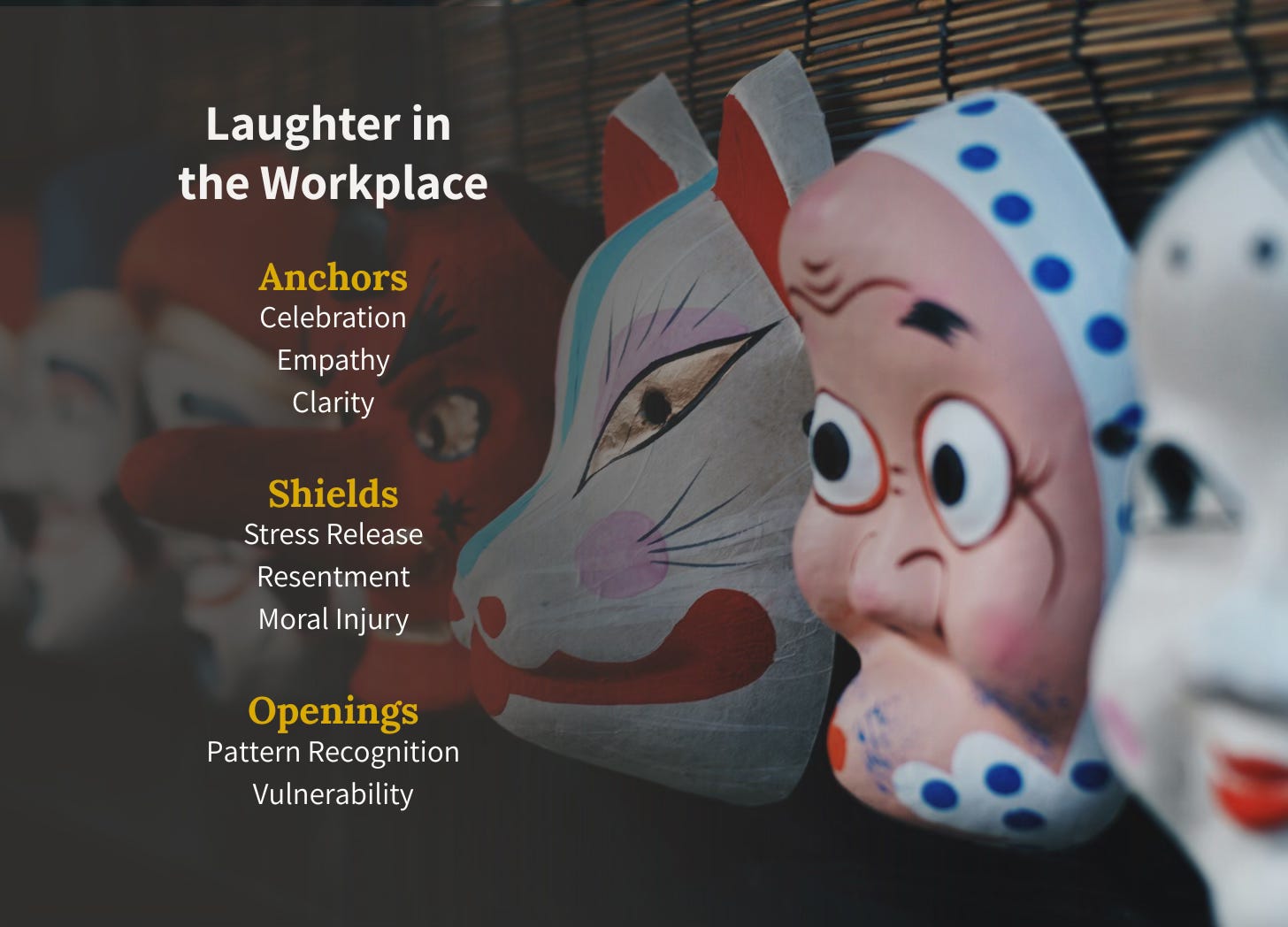
While these categories can overlap, each one contains important human signals for leadership discernment. A behavior or facial expression can have different interpretations, so hold your hunches loosely, and stay curious.
Here are some of the most common clues to understand what laughter might be trying to tell you:
Anchors: Laughter That Grounds Us
These moments of laughter occur when a person’s identity and context are aligned. There is no masking. The laughter is an expression of genuine connection—the kind of shared reality we want to anchor in as often as we can. It builds the psychological safety and relational energy associated with problem-solving, innovation, and an organization’s ability to retain top talent.
Celebration
Although it’s one of the most obvious reasons for laughter, celebration is worth mentioning because it shouldn’t be taken for granted. The rise of remote and hybrid work has changed the way we experience office humor, so it may happen on Zoom or be implied in chat threads. Banter about hobbies, sports, or work projects can foster connection and build influence. When laughter is rare or missing altogether, you might have a leading indicator of weak relationships and diminished potential for collaboration.
Your Move: Review your last few team meetings or chat threads. When celebratory laughter happens, does it feel organic or forced? If the room has gone quiet lately, ask a trusted direct report: When was the last time our team felt genuinely aligned enough to laugh together? What do you think has shifted since then?
Empathy
As leaders, we’re already mindful that our titles carry weight. Just walk into a meeting, and your position of authority creates an awareness of power over your team, whether you want it to or not. Spontaneous, unforced laughter is one of the fastest ways to meet on the same human level. It signals power with, showing your team that while you hold senior responsibility, you know the importance of being in the work together. When facing a challenge, empathetic laughter normalizes the effort of a heavy lift as a shared mission.
Your Move: Consider a recent problem you encountered. What signs of empathy do you recall, whether laughter or not? Your own ability to reflect with empathy on your experience will translate to the same capacity in how you lead. The next time a team member shares a roadblock or a near-miss mistake with you, observe the power dynamic. What’s one way you can use your tone or a bit of levity to show that you are in the work with them?
Clarity
Some of the most gratifying laughter happens when a long or intense situation finally reaches a satisfying resolution. After we have worked to solve a complex problem or make a major decision, there’s a flash of recognition: We’ve got it! In that instant, laughter is both a release and a celebration that can rally a team for the work that comes next—especially if we are intentional about connecting results back to the human effort that produced them.
Your Move: When your team reaches a milestone, take a few minutes to look beyond the metrics and discuss: What were the breakthroughs that got us here? What did we learn about how we do our best work?
Shields: Laughter That Protects Us
A lack of psychological safety in an organization or relationship can leave us with no place to catch our breath in a difficult moment. Laughter then becomes a way to save face or buy time—shielding us from the risk of exposing negative or conflicting emotions we haven’t sorted out yet.
Stress Release
When we are overwhelmed, anxious, or frustrated, a little humor can lighten the load. But if issues remain unaddressed over time, even lighthearted venting can turn cynical. Cynicism is an elegant defense mechanism that allows us to look smart and funny while avoiding agency—leaving us to carry the underlying complexity in isolation. It’s actually a white flag of surrender, showing that a leader feels powerless, regardless of their title.
Your Move: The next time you notice yourself or your team leaning into sharp, cynical humor, treat that laughter as a check-engine light. Look past the joke. What pressure is being buffered right now? What might we need to support or adjust to make the work sustainable?
Resentment
Tense laughter happens when boundaries are repeatedly crossed or strained and cannot be reasonably reset. When a leader is asked to absorb yet another change-management initiative or manage another underperforming team member, the risk of resentment increases. It might show up in a protective reflex that converts anger into a passing joke. It masks the tension in the moment and makes a difficult situation more bearable. Over time, this kind of humor can become a coping mechanism and a barrier to developing negotiation skills.
Your Move: Whether you’re alone or with a trusted person, if you let out a sharp laugh after an unrealistic request, notice if you are keeping score. Ask yourself: What boundary was crossed? In your next 1:1 conversation, frame your concern with a capacity question. Here’s a useful one: What needs to be true for this to succeed without destabilizing our existing commitments?
Moral Injury
Some of the most painful flickers of laughter reveal psychological, social, or spiritual injury in a situation that requires you to act against your conscience or deeply held values. When we seem to have no option but compliance, laughter guards against the direct heat of anger or humiliation that arises. This laughter might be a clue of what’s only starting to happen or the flare of an imminent organizational crisis. It can become a stalling tactic, tempering the experience of distress and preventing a person from leaving a harmful environment.
Your Move: If you catch yourself or a peer making light of a serious value violation, be curious: What is the difficult truth beneath the surface? Pause to acknowledge the injury, then discern what is required to recover a grounded sense of self.
Openings: Laughter That Frames a Choice
These are some of the most critical moments for a leader to influence a desired outcome, as laughter creates an opening. We have a choice: to move forward in growth or retreat into defensiveness. It may be uncomfortable, but it’s not resolved—and that’s where the opportunity lies.
Pattern Recognition
The laughter of pattern recognition might be a cynical “here we go again” or a clear “yes” of success when we see something happening repeatedly. It’s a punctuation mark on the preceding span of time, effort, and relationships. As a leader, you now have an opportunity to consider a few options: interrupting the pattern, allowing it to continue, or creating momentum around it.
Your Move: The next time you hear that collective chuckle of “here we go again” from your team, treat it as a punctuation mark on a systemic issue. Pause the meeting and ask a single question to interrupt the pattern: We all recognize the pattern we’re laughing at right now. What would it take for us to actually change it?
Vulnerability
Laughter can be an instinctive response to an awkward comment, absorbing the sudden onset of anxiety or shame. This laughter happens whether the awkwardness is unexpected, like speaking too much or too soon—or chosen, like saying the hard thing because your integrity is on the line. Either way, vulnerable laughter can be an invitation to build trust. If it’s unexpected and creates a negative impact, the situation may require an apology and the effort to make amends. If it’s chosen, trust will be strengthened or weakened in what follows that moment, including whether or not the other party is willing and able to receive what is communicated.
Your Move: Review your conversations from the past few days to identify any instance of nervous laughter. If you find one, consider returning to the conversation and clearing the air. You might say something like: I know that wasn’t easy to hear, and it wasn’t easy to say. I brought it up because I care about the integrity of our work and want us to succeed. Notice what happens to the trust in the relationship when you choose to lean into the awkwardness rather than bypass it.
What the Transcript Leaves Out
Artificial intelligence is rapidly emerging as a tool for simulating human interactions. AI chats, occasionally with video avatars, provide a responsive environment for learning. However, as we are discovering how useful AI can be, we are also encountering its blind spots. For one, it cannot interpret the nuances of relational energy between individuals, or within a group, as clues for leadership discernment.
Laughter gets lost in transcription. Text alone misses the meaning hidden in a human breath. It cannot detect anxiety about an upcoming stakeholder presentation. It cannot read the physiological stress or power dynamics that suck the air out of a room when organizational tensions are high.
When my coaching client laughed a dozen times in one conversation, she was communicating more than words. So was I when I laughed a little too hard at my team’s joke years ago.
As leaders, we have to be listening for what the transcript leaves out. We need collaborators and thinking partners who can do the same. In an increasingly automated world, learning to decode the subtext—laughs and all—is more than an executive skill. It’s how we keep leadership human.
Context Session
Many leaders reach out to me when they are at an inflection point. If you need a thinking partner alongside in making a decision or strengthening your leadership—perhaps as professional development—you can schedule a brief, no-charge Context Session to explore what it might look like to work together.
Robert, C., & Wilbanks, J. E. (2012). The Wheel Model of humor: Humor events and affect in organizations. Human Relations, 65(9), 1071–1099.
NeuroLeadership Institute. (2023). Your Brain on Laughter: How to Get Office Humor Right. NeuroLeadership Institute Journal.
While the well-known Humor Styles Questionnaire (Martin, R. et al.) classifies humor along clinical axes of target (self vs. others) and function (adaptive vs. maladaptive), this article represents those underlying dynamics as Anchors, Shields, and Openings for quick recognition when laughter occurs.